Hours of chart work, done in minutes. Every line cited.
Jubal med reads the referral packet and builds the patient, reads the whole chart and drafts the relatedness worksheet, and turns that into the addendum your hospice signs — the reading, listing and re-keying your team does by hand today. They review instead of retyping. And because every claim carries a pinned citation and a verbatim quote, the time you save holds up in a survey.
Your first 14 days are complimentary. Already invited? Sign in
The statutory authority for everything below.
Condition of participation: interdisciplinary group, care planning, and coordination of services.
What surveyors are told to check for §418.56 compliance.
When the controlling authority isn’t on file, it says so plainly and logs the gap — it never fabricates a cite.
Your team reviews. It stops retyping.
The work below is the part of a compliance seat that is reading, listing and re-keying. Jubal med does that part and hands you a draft to check.
Open the face sheet, the H&P, the medication list and the intake notes, and key the patient in field by field.
Drop the packet. The patient arrives pre-filled, and it asks only about what the documents could not answer.
4 documents → 25 fields · ~2 min
Read the whole chart, list every diagnosis, medication and supply, reason each one, and type the worksheet.
It reads every record and proposes each call with its rationale and chart cite. Your interdisciplinary group reviews, changes what it disagrees with, and signs.
Retype the unrelated items into the election statement addendum and check the form against the rule.
Built from the finalized worksheet, with the form's anatomy enforced and a second model auditing the draft.
A spreadsheet of election dates, NOE windows, recertifications and HOPE visits, kept current by whoever remembers.
Every clock runs from the election date, and each patient leads with the one that is due next.
Search the eCFR and the State Operations Manual, find the current text, and copy the quote.
Ask it the way you would ask a colleague. The answer comes back with the statute, the regulation and the guidance quoted verbatim.
a cited answer · ~1 min
Timings are from our own runs on a fictional four-document chart. Yours will vary with the size of the record.
One place for the patient, the clocks, and the paper.
On the web and as a signed desktop app for Mac and Windows. Every screen below is the real product, shown on a fictional patient.
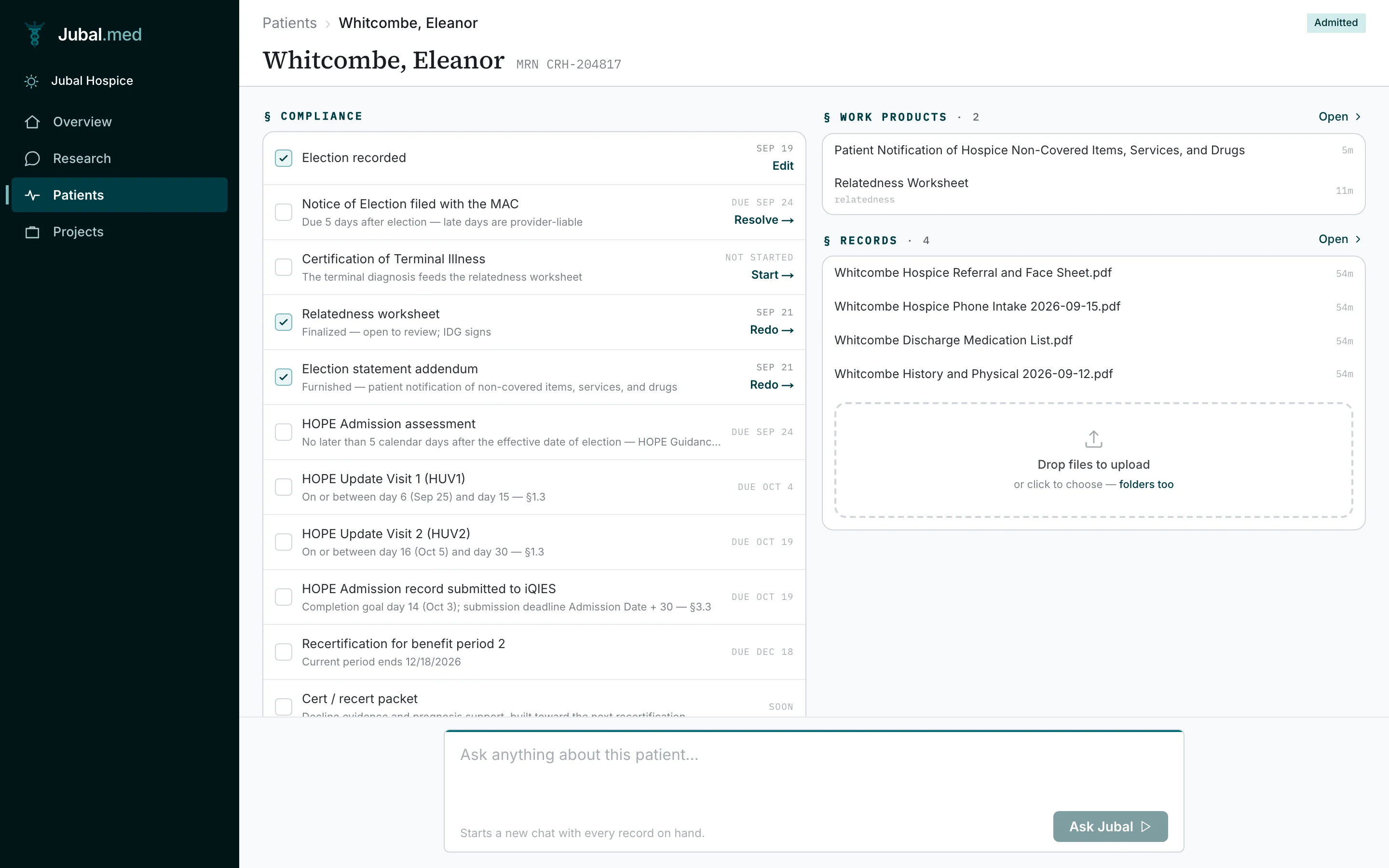
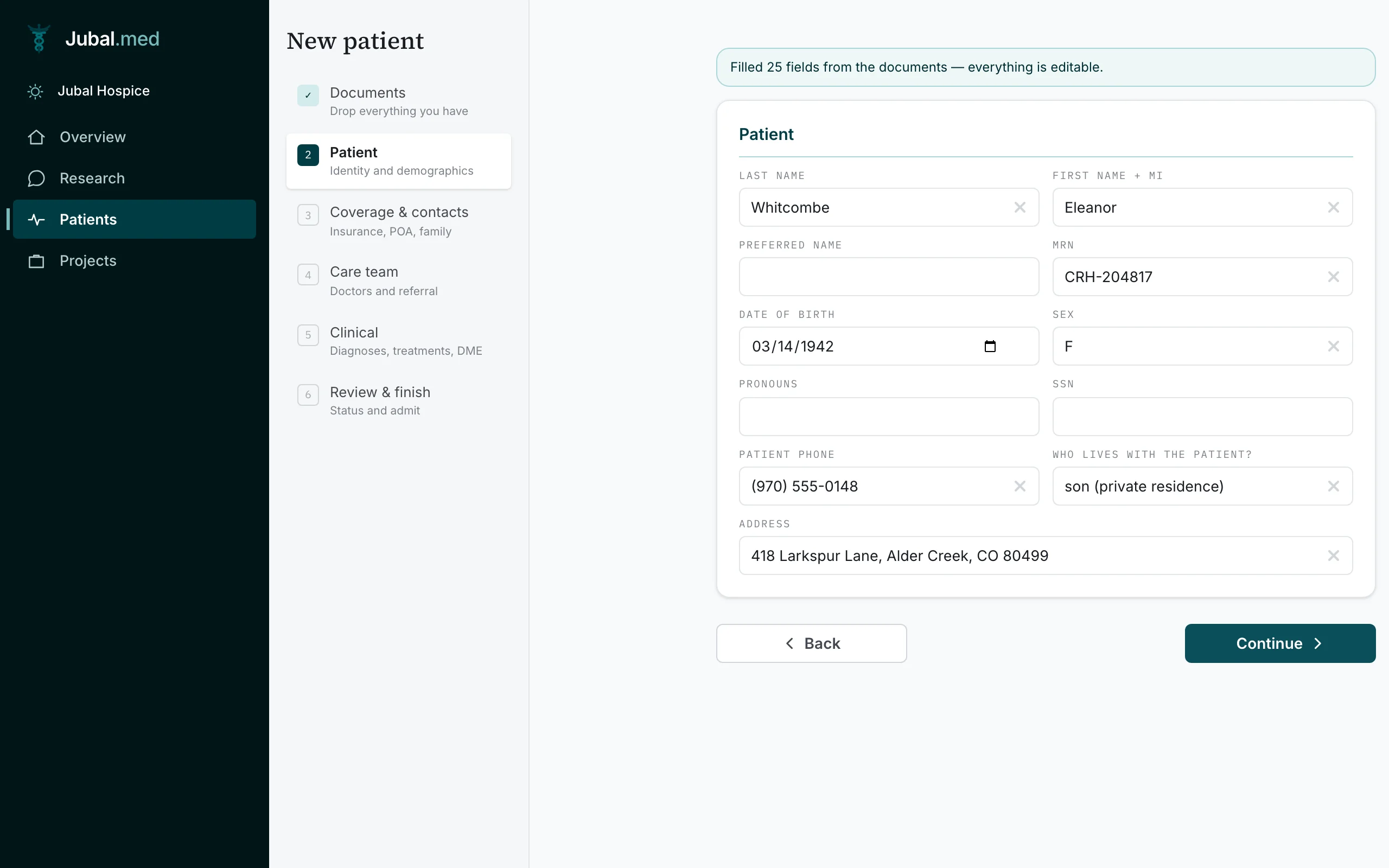
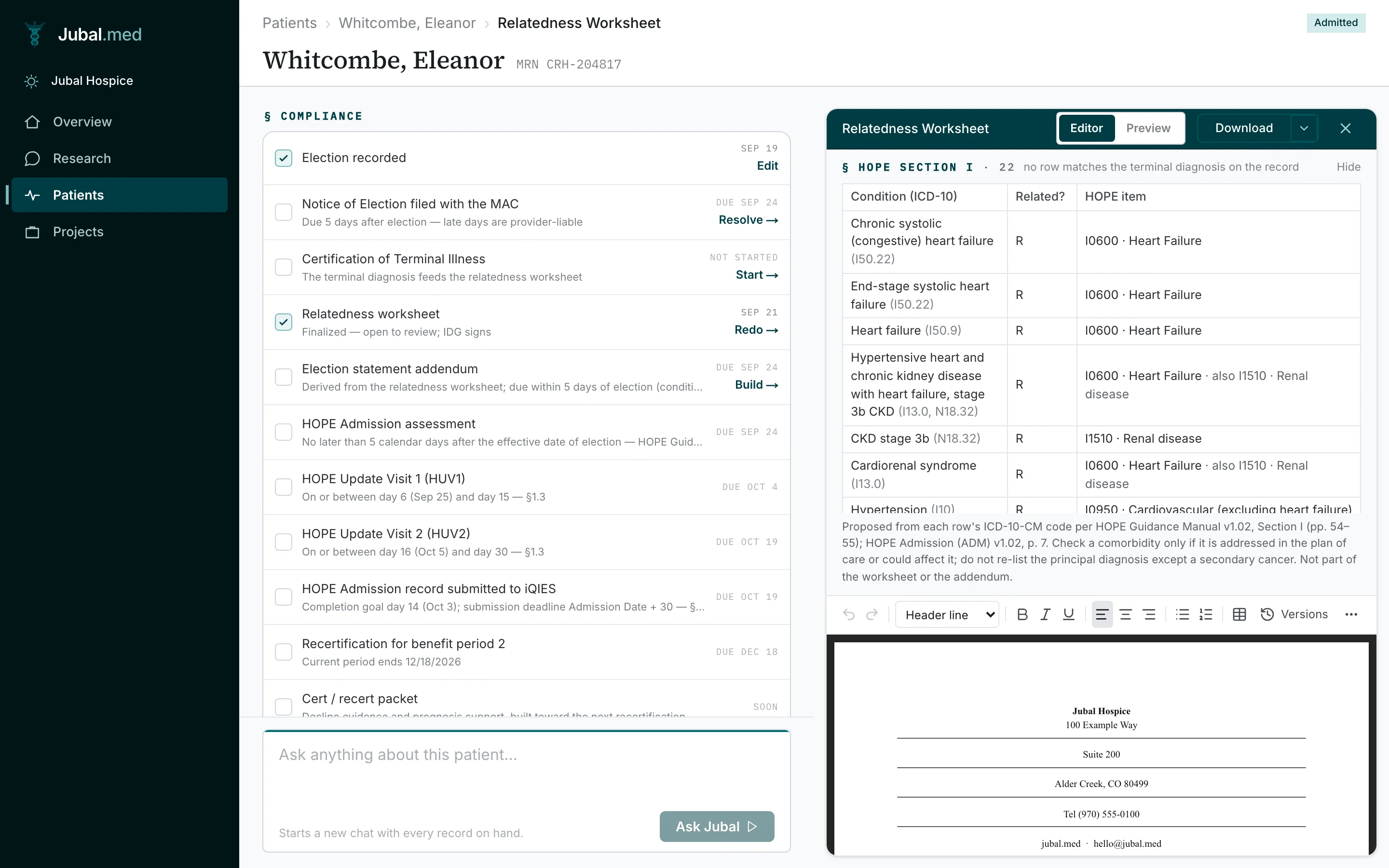
A working tool for the compliance seat.
Drop the referral packet — face sheet, H&P, medication list, intake notes. Jubal med reads every page and pre-fills the patient: demographics, terminal diagnosis, physicians, contacts. You type only what the documents could not answer, and it asks rather than guesses.
The census carries every regulatory clock from the election date: Notice of Election, the election statement addendum, recertification, face-to-face, and the HOPE assessment windows. Each patient leads with the one deadline that matters next.
The relatedness worksheet reads the whole chart and proposes related, unrelated or physician-review for every diagnosis, medication and supply — each with its rationale, its chart cite, and the HOPE Section I item beside it. Your interdisciplinary group decides; nothing ships unreviewed.
The statutory documents, built from the record: the election statement addendum, the certification of terminal illness, the NOE worksheet. Form anatomy is enforced in code, and a second model from a different vendor audits every draft before you see it.
Every question a compliance seat actually has — documentation duties, patient rights, SNF shared-patient rules, HIPAA calls — answered with the full authority stack, quoted verbatim and dated. It never guesses a cite.
It reads the law before it cites it.
Speaks surveyor, listens operator
You ask the way you'd ask a colleague. Jubal med reformulates into the corpus's terms of art and runs several probes.
Reads before it cites
Candidate sections are read in full, with provenance — source, version, retrieval time — pulled for anything that will be cited.
Answers with the stack
Statute, regulation, and survey guidance together, each quoted verbatim and dated. Guidance is always badged non-binding.
The authorities that govern you, point-in-time aware.
Citations only ever come from text retrieved on demand from this corpus. Questions it can’t ground are answered “not on file” — and every miss is logged, so coverage grows where operators need it most.
Conditions of participation across nine settings — hospice (418), hospitals (482), long-term care (483), home health (484), ASCs (416), dialysis (494), critical access (485), PACE (460)
HIPAA privacy and security (Parts 160, 164)
FDA regulations
Social Security Act statutes (§§ 1395, 1396 families)
State Operations Manual incl. Appendix M hospice survey procedures — served as guidance, never as law
28 states' statutes; Colorado also includes regulations — CDPHE facility standards (6 CCR 1011-1) and Medicaid rules (10 CCR 2505-10)
Every cite comes with its receipt.
Jubal med doesn’t carry the law inside it. It queries binding.law, our separately maintained corpus of statutes, regulations and agency guidance, and every retrieved section arrives with the source it came from, when it was pulled, a content hash, and the dates it was in force. An invented citation has none of those — which is what makes fabrication structurally unavailable rather than merely discouraged.
The rules are federal. Which ones apply depends on what you run.
Every Medicare-certified provider is surveyed against its own Conditions of Participation. Start where you actually operate.
It answers regulatory questions. It does not practice medicine.
Built — not just instructed — to refuse clinical judgment. Every question lands in one of three tiers.
Answers fully, with pinned citations.
Cites what must be done and documented — never a judgment about the patient.
Declines. Eligibility and prognosis belong to the treating clinician; Jubal med cites the process and documentation requirements instead.
The same citation discipline lawyers use, aimed at your regulations.
Jubal med is the healthcare sibling of jubal.law, built alongside working hospice operators — starting from the real disputes that cost their teams hours.
Bring a referral packet, or your hardest surveyor question.
By invitation, and your first 14 days are complimentary. When someone tells you what the rules say, Jubal med shows you what the rules actually require.